Some further observation on the Blood tetras.
[Update: These may not be Serpae tetras, so I'm referring to them by the broader term, 'Blood tetras']
One of the obvious questions about these interactions between the "Serpaes" is the question of what's aggression and what's mating behaviour. Several days ago I noticed a few of them and a few Glowlights hanging around the top of my (small) clump of Cambomba. From what I have read of breeding Serpaes, it seems that fine-leaved plants (like Cabomba, presumably) are attractive sites for Serpaes to spawn (and presumably other Blood tetras). It makes me wonder whether these fish were feasting on freshly laid eggs (though, of course, if they were, it might have been Glowlight eggs as well).
Showing posts with label characins. Show all posts
Showing posts with label characins. Show all posts
Monday, 15 September 2014

Sunday, 14 September 2014
Serpae tetra? Or not?
One of the things I noticed about my Serpae tetras (or 'Red minor tetras' as they were labelled in the pet store) was that only one of them had the characteristic black 'comma' mark behind the operculum (i.e., the gills). That one individual was also significantly redder than the other fish.
I visited the same store today and noticed that in addition to their 'Red minor tetras' they also had a tank of 'White-finned rosy tetras' (Hyphessobrycon bentosi), and that these fish matched what I had. So, I wondered, were my original fish mislabelled? And what were these fish?
First problem was that name: white-finned rosy tetras. Google around and you find 'Rosy tetras' (Hyphessobrycon rosaceus) which look a fair bit like these fish, and 'Ornate tetras' (Hyphessobrycon bentosi). So do I give Petsmart the benefit of the doubt and trust their ID of H. bentosi (though it's noteworthy that their website, unlike the store, doesn't appear to attach a species name at all to the 'White-finned rosy tetras') or should I follow the more common result on Google and assume that they're H. rosaceus?
Unsure how to proceed, I decided to get a sense of the genus Hyphessobrycon. The Wikipedia article on the genus notes that there are over 100 species (as of 2005), but only a handful of these have Wikipedia articles. That said, the coverage of commonly kept aquarium fish is pretty decent, so I decided to see how well I could match my fish with those covered.
Some of them were easy to dismiss as candidate species. Hyphessobrycon columbianus, the Colombian tetra, is described as being silver-grey in colour with a turquoise tinge from the lateral line upward. Several others were also easy to dismiss: H. herbertaxelrodi (the Black neon tetra), H. heterorhabdus (the [Belgian] Flag tetra), H. megalopterus (the Black phantom tetra) H. anisitsi (the Buenos Aires tetra) and H. pulchripinnis (the Lemon tetra) are all easy to rule out; they look nothing like these fish. But that still leaves quite a few candidates (among the species with Wikipedia articles) that required closer examination.
Ruling these species out was the easy part. Identifying a good candidate among the remaining species was a little more difficult. Hyphessobrycon amandae (the Ember tetra) appears to have a narrower body and smaller fins. The Flame tetra (Hyphessobrycon flammeus) has the right body shape, but has a pair of vertical bars. My fish also lack the prominent red spot associated with the Bleeding heart tetra (H. erythrostigma). This left five reasonable candidates: H. bentosi, H. eques, H. minor, H. rosaceus and H. sweglesi. These five deserved more careful examination.
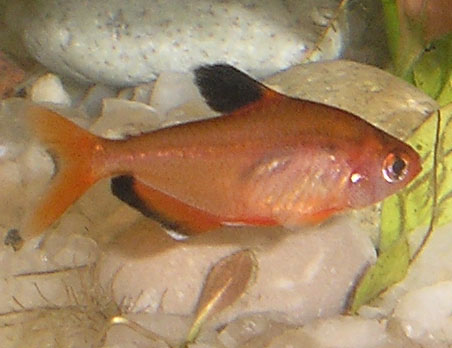
My fish (Hyphessobrycon sp.)
My fish are orange-red tetras with a relatively thick body. The dorsal fins are back with white edging; the forward third of the dorsal fins are also white or red. Only one of them has the red 'comma' mark typical of Serpae tetras (though apparently not invariably present.
Hyphessobrycon eques (Serpae tetra)
This was, after all, my first guess. The best argument against my fish being Serpaes is the fact that one of them clearly is, and he looks different from everyone else.
Hyphessobrycon minor (Minor tetra)
Given that these fish were labelled 'Red minor tetras' in the pet store, you'd think that 'Minor tetras' would be a very good guess for the identity of these fish. The problem is that this week, in addition to the 'White-finned rosy tetras' they also had a tank of 'Red minor tetras'. And in fact, these appeared to be Serpaes. That said, of course, assuming that the following image is correctly identified, it would be easy to confuse the two.
Finding anything about these fish via Google is nearly impossible, since searches for 'Minor tetra' is going to be subsumed into searches for 'Red minor tetra'. The main distinguishing factor I can find is size, and since these fish are not fully grown, it isn't the most helpful.
Hyphessobrycon sweglesi (Red phantom tetra)
Another fish that looks very like a Serpae tetra, but this time with an even bigger spot behind the gills.
Hyphessobrycon bentosi (Ornate tetra)
The tank I saw today at Petsmart was labelled 'White-finned rosy tetras' (Hyphessobrycon bentosi). They looked a lot like the fish I bought, but that doesn't mean they are the same.
Assuming that these pictures are correctly identified, the most notable difference (other than the body colour, which can wash out in stressed fish) is the lack of a black spot at the far end of the anal fin. Animal-World has the following to say about distinguishing these tetras from H. rosaceus (the Rosy tetra).
Hyphessobrycon rosaceus (Rosy tetra)
This brings us to our final candidate, the Rosy tetra. After all, the fish today were labelled as 'White-finned rosy tetras'.

Problems begin with the descriptions of the species. From Wikipedia
Conclusions?
So what do I have? I don't know. Only the Serpae tetras and the Minor tetras had the black spot on their anal fin in any of the pictures, but sadly none of the species descriptions matched them at all. All I know right now is that I have some sort of Blood tetras. Beyond that, I'm still uncertain.
Unsure how to proceed, I decided to get a sense of the genus Hyphessobrycon. The Wikipedia article on the genus notes that there are over 100 species (as of 2005), but only a handful of these have Wikipedia articles. That said, the coverage of commonly kept aquarium fish is pretty decent, so I decided to see how well I could match my fish with those covered.
Some of them were easy to dismiss as candidate species. Hyphessobrycon columbianus, the Colombian tetra, is described as being silver-grey in colour with a turquoise tinge from the lateral line upward. Several others were also easy to dismiss: H. herbertaxelrodi (the Black neon tetra), H. heterorhabdus (the [Belgian] Flag tetra), H. megalopterus (the Black phantom tetra) H. anisitsi (the Buenos Aires tetra) and H. pulchripinnis (the Lemon tetra) are all easy to rule out; they look nothing like these fish. But that still leaves quite a few candidates (among the species with Wikipedia articles) that required closer examination.
 |
| The Black neon tetra, H. herbertaxelrodi, is clearly distinct in both colour and body shape from these tetras. Photo copyright Juan R. Lascorz, licensed under the Creative Commons Attribution-Share Alike 3.0 Unported license. |
My fish (Hyphessobrycon sp.)
My fish are orange-red tetras with a relatively thick body. The dorsal fins are back with white edging; the forward third of the dorsal fins are also white or red. Only one of them has the red 'comma' mark typical of Serpae tetras (though apparently not invariably present.
 |
| Note the black dorsal fin edged with white. The front end of the dorsal fin can also be white or red. The anal fins are also white-edged, with a black dot at the rear edge (not visible here). Also not visible are the white edges on the pelvic fins. |
 |
| Same group of fish. Note the black spot at the distal end of the anal fin (clearly visible in the top fish). |
This was, after all, my first guess. The best argument against my fish being Serpaes is the fact that one of them clearly is, and he looks different from everyone else.
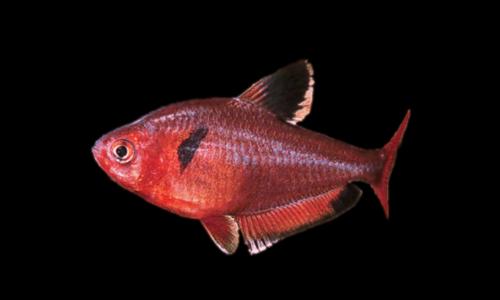 |
| The black line behind the gills is clearly visible, as is the more intense red. Photo courtesy MiguelCampos, released into the public domain. |
Hyphessobrycon minor (Minor tetra)
Given that these fish were labelled 'Red minor tetras' in the pet store, you'd think that 'Minor tetras' would be a very good guess for the identity of these fish. The problem is that this week, in addition to the 'White-finned rosy tetras' they also had a tank of 'Red minor tetras'. And in fact, these appeared to be Serpaes. That said, of course, assuming that the following image is correctly identified, it would be easy to confuse the two.
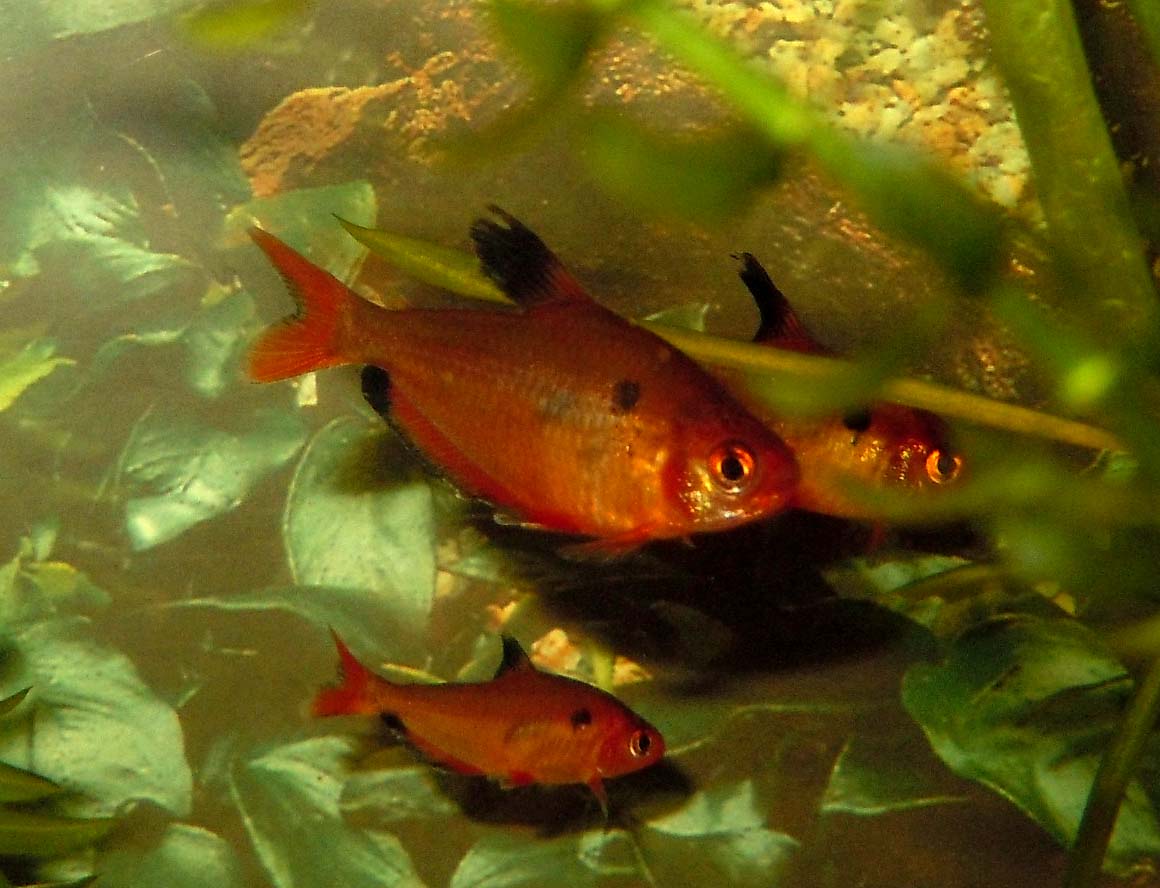 |
| Copyright Yuriy Kvach, licensed under the Creative Commons Attribution-Share Alike 3.0 Unported license. |
Hyphessobrycon sweglesi (Red phantom tetra)
Another fish that looks very like a Serpae tetra, but this time with an even bigger spot behind the gills.
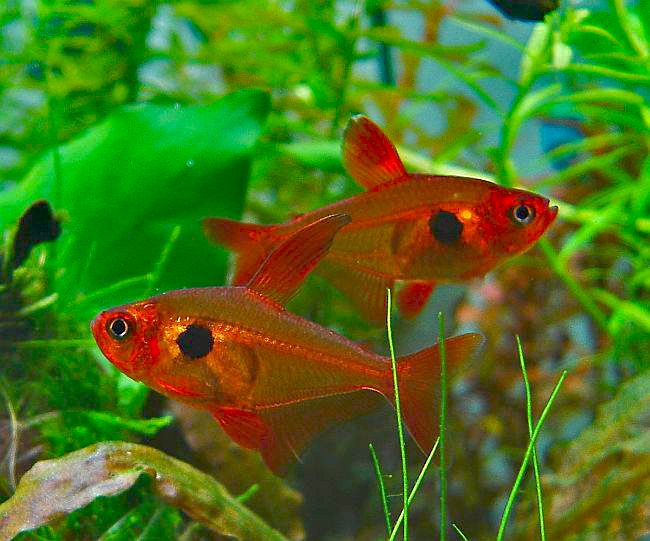 |
| Courtesy Tsunamicarlos; released into the public domain. |
Hyphessobrycon bentosi (Ornate tetra)
The tank I saw today at Petsmart was labelled 'White-finned rosy tetras' (Hyphessobrycon bentosi). They looked a lot like the fish I bought, but that doesn't mean they are the same.
 |
| Hyphessobrycon bentosi, Copyright Euripides, licensed under the Creative Commons Attribution-Share Alike 3.0 Unported license. |
 |
| Copyright H. Krisp, licensed under the Creative Commons Attribution 3.0 Unported license. |
These two tetras are so similar in appearance that this fish is commonly known as the False Rosy Tetra. Both have a pink to deep salmon colored body, though this species is a bit more transparent. They also each have darker red markings on their fins. They differ in that the Ornate Tetra always has white tipped fins while the Rosy may or may not, and the Rosy has a black marking or 'flag' on its dorsal fin. Other common names this tetra is known by include White Tip Tetra, White Fin Ornate Tetra, and Bentos Tetra.Not entirely useful, but it does suggest that the paler colour of these fish may not be incidental.
Hyphessobrycon rosaceus (Rosy tetra)
This brings us to our final candidate, the Rosy tetra. After all, the fish today were labelled as 'White-finned rosy tetras'.
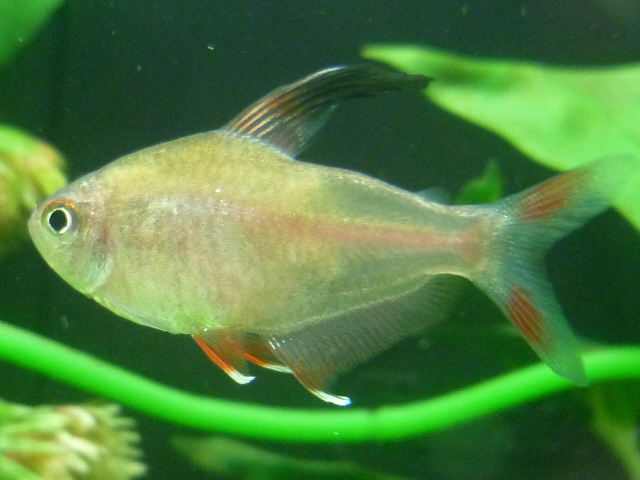 |
| Copyright Aquakeeper14, licensed under the Creative Commons Attribution-Share Alike 3.0 Unported license. |
The rosy tetra has a light pink-white body with red fins, except the dorsal fin which can be black or white, and the caudal fin which is pink-white with two elliptical red spots on it. It has a faint black line from the top of its eyeball through the pupil, to the bottom of the eyeball.Animal-World has this to add
The Rosy Tetra Hyphessobrycon rosaceus is a fun addition to a peaceful community aquarium with other smaller fishes. It has the deep bodied shape of the larger tetras like the Bleeding Heart Tetra. It is also quite pretty with its deep salmon body color highlighted with red accents and bright white tips on the fins.
Conclusions?
So what do I have? I don't know. Only the Serpae tetras and the Minor tetras had the black spot on their anal fin in any of the pictures, but sadly none of the species descriptions matched them at all. All I know right now is that I have some sort of Blood tetras. Beyond that, I'm still uncertain.
Saturday, 13 September 2014
Observations on Serpae tetra behaviour
As I mentioned previously, I recently acquired a school of Serpae tetras. And they weren't quite what I expected (though the fault was mine for not doing better research). So a couple weeks on, what do I think of them?
[Update: These may not be Serpae tetras.]
To their credit, they're attractive, active fish. They use the entire water column (at least with the tank-mates they currently have) but seem to favour the front of the tank. (Again, that might be specific to these fish, but they certainly are aware of humans and know that we're a source of food).
They are strongly motivated by food. My Glowlight tetras have limited interest in a block of dried tubifex (they will eat the floaters dislodged by other fish, but they won't attack the block itself) and almost none in algae wafers. The Serpaes, on the other hand, will greedily attack dried tubifex and sinking algae wafers. While the Glowlights will spit out flakes that are too large for them, the Serpaes hold onto any food and eventually swallow down whatever they get a grasp on (often looking like they're at risk of choking on the food, though I suppose that in order to choke you need lungs).
As tetras go, they're fairly aggressive. While most of the aggression is directed at conspecifics, they Serpaes seem to have effectively banished both the Corys and the Glowlights from their preferred terrain (the front of the tank) except when food is present, when they seem to focus their aggression on conspecifics. The intraspecific aggression is interesting - one fish will go at another with its dorsal and anal fins expanded. Sometimes the fish that's attacked will swim off (in which case the aggressor seems to give chase) while other times they will spin around and stand their ground, responding with a similar display. The two combatants may clash a couple times before one retreats, though rarely very far. This sort of thing usually happens around food, especially algae wafers.
Tubifex blocks are very light, very low density - they're just freeze-dried worms compressed into a block. Once they fish start to attack them, they are quickly dismembered (especially if the fish in question are Serpaes or Kuhli loaches...Corys, which don't actually bite into things, can't break the block up as quickly). Once the Serpaes get to them, they don't last very long. Algae wafers, on the other hand, as fairly solid, although they gradually soften up as they soak in water. Since they last longer, they are soon covered with a scrum of Corys which completely cover the block and only offer armoured tails to the Serpaes. As a result, the Serpaes gather around above the wafer, waiting for the wafer to be exposed (which happens every now and then as the Corys move the wafer around and flip it over, and every so often seem to lose the wafer entirely). It is at this time, when the Serpaes are gathered together for a prolonged period, without clear access to the food, that I observe most aggression.
I hope that as the plants grow the sight-lines in the aquarium will be more broken up and life will become more peaceful.
Saturday, 6 September 2014
More on Serpae tetras
After observing them for a week in my main tank, I can report that Serpae tetras may not be quite what I expected them to be.
[Update: These may not be Serpae tetras.]
I have kept a number of tetras over the years (neons, cardinals, rummynose, glowlights) and I have always found them to be exceptionally well suited to a community aquarium - they are peaceful, attractive fish that bring life and colour to the mid-waters of the tank. While they are strikingly pretty fish which bring life to a tank, my Serpae tetras are far less peaceful than the other tetras I've kept.
For starters, they are aggressive feeders. While glowlights will spit out food that's too big for them (and maybe take a second or third bite at it), the Serpae tetras would not let go of a piece of food once they had a bite of it. They also go after food quite aggressively, even challenging the (must larger) Corydoras and kuhli loaches. Again, unlike the glowlights, which rarely go after food on the bottom of the tank, the Serpae tetras will go in for it.
They are also much more aggressive tetra-to-tetra. They will bully the glowlights just a little, but far more noticeable are the occasional clashes with their conspecifics. Just a few of the largest fish fight with one-another, but as they settle in, these clashes seem more common. I doubt schooling tetras are likely to be territorial, so presumably this has more to do with setting up a dominance hierarchy.
Tuesday, 2 September 2014
Serpae tetras
 |
| Hyphessobrycon eques. Photo by Alexander Dubrovsky, released into the public domain. |

[Update: These may not be Serpae tetras.]
Although the fish I keep are generally South American, I have barely scratched the surface when it comes to tetra diversity. Mostly I've seen the long-finned variety in pet stores, and they always struck me as slightly sad, slightly clumsy-looking fish. These guys though are attractive little fish, fairly active in the mid and upper water of the tank, willing to school near (or even with) my Glowlight tetras.

I can't speak for them in the long term, but thus far, I'm happy with the addition.
Thursday, 17 January 2008
Guyanese fish
My new Guyanese fish (Glowlight tetras, Hemigrammus erythrozonas) seem to be adapting to their new home. They are pretty fish, and they look good among the plants. Unfortunately, they aren't terribly active. Not only do they move around less than the Corydoras panda and Corydoras trilineatus, they actually use less of the tank (vertically) than do the pandas.
In their favour, the Glowlights tend to school, and when they move together, it's an impressive sight. That probably means that I need a lot more than six of them - the more there are, the bigger the impact. In addition, of course, they are also likely to be bolder in larger groups. Hopefully, as they get more accustomed to their new homes, the Glowlights will start using more of the water column. One can hope, anyway.
In their favour, the Glowlights tend to school, and when they move together, it's an impressive sight. That probably means that I need a lot more than six of them - the more there are, the bigger the impact. In addition, of course, they are also likely to be bolder in larger groups. Hopefully, as they get more accustomed to their new homes, the Glowlights will start using more of the water column. One can hope, anyway.
Wednesday, 16 January 2008
Glowlight tetras
Having lost my angels, I have been looking for some open-water swimming fish for my main tank. I have been considering tetras or White Cloud Mountain Minnows for the last couple weeks, but nothing really jumped out at me. So today I finally decided to go with Glowlight tetras, Hemigrammus erythrozonus. I wish I had made the decision after careful consideration of the biology and behaviour of the species, but I actually just narrowed it down to the ones I liked most, and based my final choice on the tank that had the healthiest-looking fish. That said, having spent two weeks looking at what was available locally and ruling out the ones that seemed too prone to fin-nipping, the decision wasn't just based on a whim. But neither was it the fulfillment of my quest for the "perfect" fish to fit my needs.
That said, I'm pretty happy with my choice thus far. They look pretty good in my tank, and they are schooling nicely. They're quite active and add colour to the tank. Unfortunately, they appear to prefer the lower third of the tank. They are venturing into the upper parts of the tank, which is encouraging - hopefully, as they grow more comfortable they will make more use of those areas.
That said, I'm pretty happy with my choice thus far. They look pretty good in my tank, and they are schooling nicely. They're quite active and add colour to the tank. Unfortunately, they appear to prefer the lower third of the tank. They are venturing into the upper parts of the tank, which is encouraging - hopefully, as they grow more comfortable they will make more use of those areas.
Monday, 14 January 2008
Restoring sight in blind cave fish
Ed Yong of Not Exactly Rocket Science writes
In this environment of perpetual darkness, the eyes of [the ancestors of blind cavefish (Astyanax mexicanus)] were of little use and as generations passed, they disappeared entirely. They now navigate through the pitch-blackness by using their lateral lines to sense changes in water pressure.But there is a deceptively simple way of restoring both the eyes and sight that evolution has taken, and Richard Borowsky from New York University’s Cave Biology Research Group has found it. You merely cross-bred fish from different caves.
So how does this work? Obviously the lack of eye development is the result of different mutations in different caves. In different caves, different gene mutations resulted in the loss of eyes.
Subscribe to:
Posts (Atom)