Showing posts with label Aquascaping. Show all posts

Wednesday, 2 January 2019

Hope springs eternal


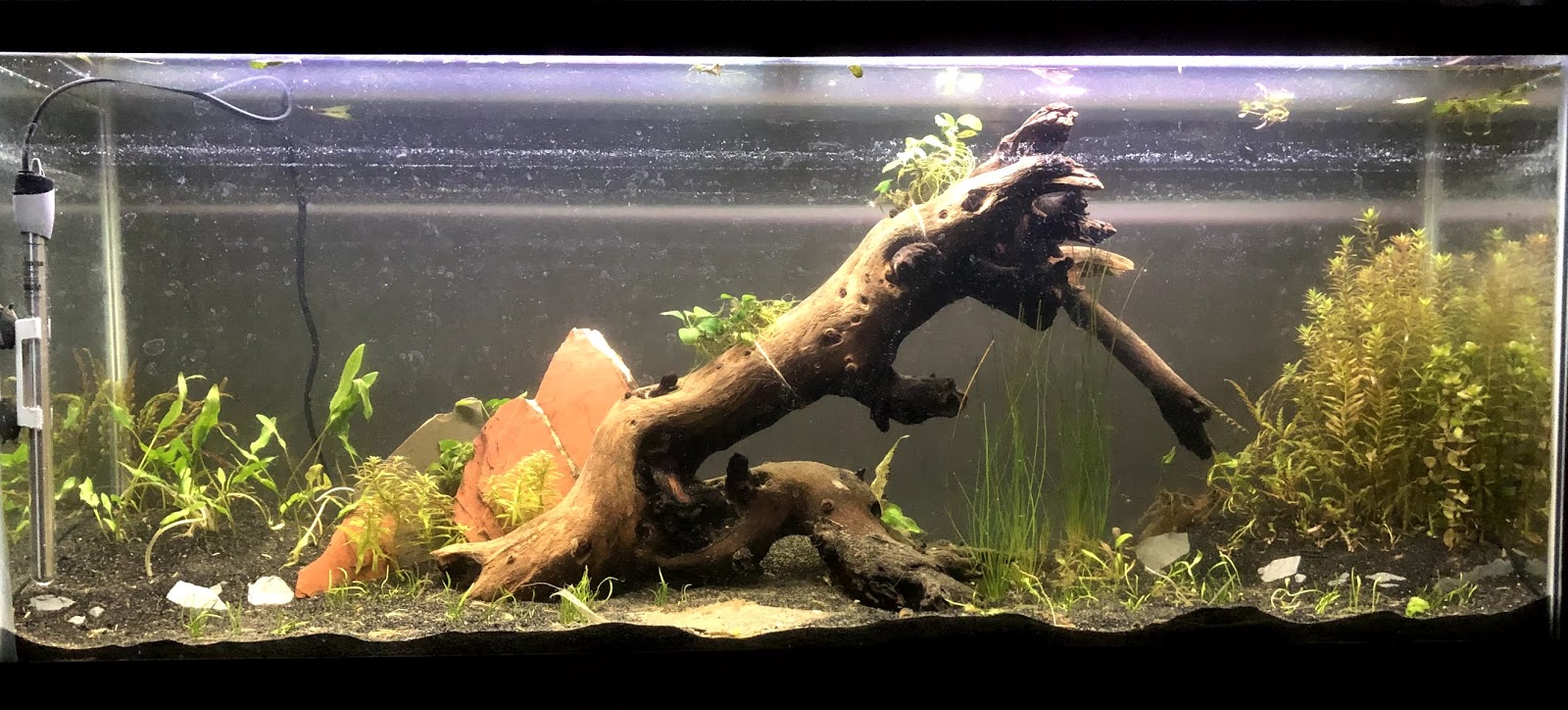
Bad tank experiences can be disheartening, but I'm far from ready to give up my dreams of the perfect planted tank. We moved again last year, and my fish went into what were supposed to be "temporary" accommodations. My main tank sat empty in the garage for a while, and then sat empty in my office for a while longer.

I wanted to create raised terraces in the corners, but my previous attempts hadn't worked. If you mound the substrate to the back, it eventually levels out. If you try to keep sand behind barriers, it slides around or under them (and I'm just not ready to glue things to the base of my tank. Finally I went with a mix of substrates - coarser gravel in the back corners and a plastic mesh supported by a "wall" of small pieces of slate. I covered that with sand and...it seemed to hold up.

I added some hardscaping, a large piece of driftwood, and started filling the tank. The raised portions seemed to hold up well, but I ran into the problem of floating driftwood. The piece of driftwood I was using had sat out of the water for more than three years. Since it was much too big to attempt the usual recommendation for floating driftwood (boil it to drive out the air) my only real option was patience. So I left things alone for a few more weeks while the driftwood became waterlogged.

Finally I bought some plants, got things set up, and finally I have a tank.


I'll give the plants a while to get established before I add fish, filtration, and maybe, just maybe, a CO2 system.

I'm hopeful things will turn out better this time. The old location seemed good, but it did have light shining through a south-facing window into a corner of the tank. That might have been a large part of my algae problem. They say that CO2 additions tend to tip the balance in favour of vascular plants. So if I got that way, I might have fewer problems. And, I suppose, I just need to intervene more. As much as I like Java moss, it might not be the best way to go - it's impossible to get algae out of Java moss. So I'll see.

Friday, 14 August 2015

A blank slate

Another move and I'm back to a blank slate. Especially since I managed to kill all my abundant plant collection (probably has a far higher replacement cost than my fish, which made the trip quite well and and healthy, if unhappy, in temporary accommodations.
Lots of potential - really I'm limited only by my imagination and my budget (both of which are very real constraints). So where do I go...?

Saturday, 28 February 2015

A lack of updates

Both the excitement and the frustration of aquarium-keeping tend to come within the first few months of setting up a tank. Algae outbreaks tend to be par for the course. New fish bring with them a fascinating repertoire of behaviours, but can also bring problems (disease, conflict, failure to thrive). And the plants you put so much effort into setting up and arranging just the way you want them seem to have a mind of their own. Some you hoped to fill out die or get uprooted, while other spread like weeds.

After a few months, things tend to work themselves out. The fish adapt to your tank and to their new tank-mates. The plants get established (or die) and your main concern tends to be trimming them back and working on a coherent aquascape. (There's always the challenge of filling that one troublesome spot, or that one troublesome plant, but it tends to become a minor annoyance you're happy to live with.) Algae problems never go away, but they fade into the background. All is well and you can sit back and enjoy your tank.


That's about the time you start thinking about setting up a new tank, and replaying those problems all over again.

Tuesday, 2 September 2014

Planting dwarf hairgrass

As part of my aquarium re-do I decided to add some dwarf hairgrass (Eleocharis parvula) to the foreground. The plants I bought formed a dense mat of runners that I separated into a number of large clumps that I anchored with half a toothpick. While the clumps stayed put pretty well (although foraging corys uprooted a couple of them) I was left with a lot of smaller bits floating on top of my tank. While it was only a small portion of what I had bought, it was still a lot of plants, and it seemed wasteful to discard them (or really, just let them float until they were battered to death by the water flow).

Having done the planting I found myself wondering how I should have done it. I looked around online and found this video.

It looked like an interesting, albeit labour intensive, way of getting things planted, so I tried it with my leftover floating bits of the plant.

As I thought, it's tedious and labour intensive. I gave up after a dozen or so plantings. It was also a very effective way of getting the plants rooted - something I wish I had learned years ago. I tried it with a fragment of Ludwigia that had floated in the tank for the last two weeks (and grown a long root). It worked just as well. While I'm a little concerned that I might be burying the stems a bit too deep in the substrate (though, luckily, it's just gravel) I'm not too worried. I'll see how things work. So far though, it seems like a good technique for planting any small aquarium plants, especially those that come as cut stems with no real root mass. (I wouldn't, for example, try that technique with a sword.)

Thursday, 14 August 2008

Tank talk and lighting options

As often happens, I went through a period of neglecting my tanks, especially my (55-gallon) main tank. It's the kind of thing that happens to almost every aquarist at some point in time. The main tank has always been light-deficient - while most people recommend 2-3 watts per gallon* for a planted tank, my plants were forced to get by with approximately 0.55 watts per gallon. As long as I was feeding them Flourish Excel, the plants seemed happy (especially the Cambomba), but once I quit, only the Java fern and Echinodorus ("Amazon swords") did much.

While the main tank was suffering a lack of plant growth (somewhat masked by the expanding Java ferns), my other tanks were experiencing the opposite problem - too much plant growth. The plant tank was covered by an emergent carpet of Ludwigia and Bacopa monnieri; the tank itself had turned into a mass of roots. The Otocinclus tank was similarly overgrown, although instead of being covered by emergents, it was covered by a think layer of floating plants.

At the end of July I shook myself out of my torpor and started moving plants from the plant tank to the main tank. I realised that I had to upgrade my lighting, but at that point in time, it just wasn't an option. I replanted a lot of Ludwigia and a little Bacopa into the main tank, and cleaned up the mass of floating vegetation (I either replanted the stuff, or got rid of it). And then I had to leave it all alone for a week and a half.

One of the main reasons I wanted to clean out the plant tank was the fact that we would be gone for a while. I don't have a timer on that tank, so I have just left the lights on when we are gone. One time I returned to find the tank a thick mass of hair algae - so thick, in fact, that the water was obviously not circulating (some areas were very warm, others were far too cold). While that is likely to be less of a problem in summer, I still wanted to clear out enough vegetation to give it some room to grow. But moving plants to the main tank created a problem - did I really want to go to all that effort, and then watch the plants turn into spindly things before slowly dying? While a lighting upgrade was in order, I had neither the time nor the money for anything of the sort.

On the way home from Michigan I finally stopped into Preuss Pets in Lansing, Michigan. A friend of mine has been saying great things about them for years, all the more now that they have moved to a larger place (more later). I ended up buying a really nice new lighting system, and I now have two 54 watt bulbs on the tank. Not too surprisingly, the change was remarkable. I have also continued to move plants from the plant tank to the main tank. It's too early to say home much of it will really take (a lot of what I transplanted was emergent in the old tank, so it will have to adapt to being submerged), but the tank looks great and the fish seem happy, poking around in the new vegetation.

* It's actually more complicated than simply "watts per gallon" - not only does the light output matter (not all 30-watt fluorescent bulbs are the same), it also matters what wavelengths the bulbs produce.

Sunday, 24 February 2008

Otocinclus tank

It's been almost a month since I re-did the former Macropodus tank. After I cleaned the tank out and added some new plants, the old plants died back seriously. It was especially noticeable with the Echinodorus, which had previously dominated the tank. Their leaves first went pale, and then much of the tissue died, but not the whole leaf.

Apart from adding a lot more plants, I also created a small "sand lens" in the front of the tank. And, of course, I added a population of Otocinclus and two dwarf corys. So how have things changed?

Here's the tank today; while I'm having a hard time getting the Lilaeopsis to root, the Hemianthis is really coming along nicely.

Here's the tank three weeks ago, when the die-back had just started


And here's the tank three days before that, shortly after I had cleaned it out

Sunday, 3 February 2008

Tank shots

In the past couple days I added more plants to the tank, trying to create something of a thought-out aquascape (or at least something that could be thought of as something like a thought-out aquascape. Here's how it looked three days agoI added Hemianthis, Lilaeopsis and some Vallisneria to the forground, and planted a number of stems of Cabomba along the back, in front of the heater. I also added some Ludwigia along the centre, to add some more dimension. This is the way it looks now

Thursday, 31 January 2008

Display tank or breeder?

As I mentioned previously, I now have an available tank to stock. The first step was cleaning it up - the tank was badly overgrown and the substrate was very dirty. Over the course of cleaning it took 10 or 15 gallons of water out of a 10-gallon tank - and even then, I didn't get the substrate completely clean.I took out most of the Rotala - it just hadn't taken very well in that tank. I also pruned the Echinodorus plant rather severely - that should let more light through. I may need to add some more plants to the foreground, from the perspective of a "planted tank" it has a major deficiency - the lack of adequate substrate. The tank has nothing but rather garish red and black gravel. In the course of cleaning it up, I took most of the organic material out of the substrate, thus removing most of its nutrient-holding capability.Now I need to figure out what to do with this tank. Do I want to give the corys a chance to breed? Having done so much to make the tank pretty, do I really want to turn it into a breeder? Or to put it differently - can I make a breeding tank visually interesting? If I had a few more pandas I could make a little shoal of them...but the reason I want to breed pandas is my lack of pandas.

Friday, 30 November 2007

Aquascaping, part IV

One of the common complaints about aquarium plants is that, as they grow taller, they lose their lower leaves. This is especially true in lower light situations. Most people will recommend trimming the plants, removing the bases and replanting the tops. In a mature, heavily-planted aquarium that's probably the right idea. But when you are trying to grow a stock of plants, it isn't the best idea - in that case, the objective is to maximise your stock of planting material.

When you prune a plant, it will normally produce new shoots from an existing axillary bud. These buds are located at the point where the petiole of a leave joins the stem (or where one used to be before the leaf was shed). When a stem it pruned, one or more axillary bids start to grow. This can produce a bushier plant, but the appearance isn't always what you would want, since you end up with a distinctly smaller shoot coming off of a larger stem.

If the branch develops from the topmost axillary bud, there's a chance that it will develop into a new leading stem. But will that really create the desired look? This is far more important for foreground plants than it is for background plants, of course. From this perspective, it seems like it would make sense to cut plants back are low as possible, leaving an almost indistinguishable old stem. The obvious problem there is the danger of cutting it back too far. The plant can only produce new stem material if it has the resources to do so. How little is enough? That's not only going to vary from species to species, it's also going to vary from individual to individual. A small scrap of Java fern leaf will grow into a new plant, but how little Ludwigia stem (to use the example in these pictures) will produce a new plant?

There is, of course, another problem as well. Large, healthy plants do not appear out of nowhere. If you prune too heavily you may end up with a large stock of skinny, sad-looking plants.

Thursday, 29 November 2007

Aquascaping, part III

Adding rocks created a little more dimension to my tank, but it still wasn't enough. Around the same time I set up the plant tank (or perhaps it would be better to call it a plant nursery, since that is how I originally envisioned it) and purchased a few more plants. Perhaps it was serendipity, but I got some new Cabomba and Water wisteria (Hygrophilia difformis), together with some new Ludwigia. Without high-grade lighting and CO2 injection, I am not going to be able to establish the sort of super-dense garden tanks that are so popular these days. I shouldn't be trying to mimic those setups - I need to work on producing the best aquascape I can, given my constraints. But I can still learn from them without resorting to a crude caricature, a child's imitation.

Although it didn't start well, I have been very happy with Cabomba. Initially it became very stringy, elongating its internodes in a push for the surface of the water. But now, it has thickened up pretty well and filled out. But trimming and replanting the tops, I have the makings of a nice little Cabomba forest. The cut stems have resprouted, and a few uncut stems have also sprouted. While it doesn't seem to match well with modern ideas about aquascaping, it has a "natural" feel to me, the feel of a macrophyte-filled lake. The water wisteria were planted in an area behind the driftwood, adjacent to the smaller of the Echinodorus. The divided leaves emerge from an area dominated by shorter plants with narrow, elongate leaves. I like the effect, but it's a little asymmetrical.

I recently read an article about Dutch aquascaping. While the practice stresses garden-like layout and terraced arrangement isn't something I plan to implement, I was struck by the idea of using "pathways" to create an illusion of depth. I really think that's something I could make use of.

Saturday, 24 November 2007

Aquascaping, part II

Over the course of the next few months I added a few plants - most notably a couple Spathiphyllum plants - not true aquatics (although I didn't know that when I bought them), but they can survive for extended periods underwater - and a couple more Echinodorus. The Spathiphyllum anchored the back right corner of the tank, while the new Echinodorus plants occupied spaces on either side of the filter intake.

Echinodorus, the "Amazon swords" are an interesting - and diverse - group of plants. My original ones were a tall species - once they get large enough, they produce emergent leaves. They would make nice pond plants and would be good in open tanks, but they really aren't idea for the setup I have unless you are willing to do some major pruning. From what I have read, pruning the roots is probably the most efficient way to produce a smaller plant. The corys excavated the root ball of one of the large Echinodorus, which had the desired effect of dwarfing the plant (for the time being, anyway). I may trim the root mass again in a few months, or try dividing the plant. The other species of Echinodorus is very different - it's really the idea plant for my setup. It has shorter petioles and more lanceolate leaves. Ever since I switched to 6500 K plant bulbs it has produced smaller, denser leaves. It makes a good background plant, filling space at the back of the tank. Since the plants came with plantlets (flower spikes which had either failed to break the surface or, more probably, been submerged when the plants were prepared for shipping), I planted them in what became the Macropodus tank. They seem to have done well in that overgrown, badly overstocked tank. Since I upgraded the lighting in there (from the original incandescent bulbs to compact fluorescent) they seem to be doing better. Unfortunately, conditions in that tank favour algae growth (no snails, excess nitrates) so the leaves tend to have a lot of epiphylls (plants that grow on the leaves of other plants; in this case, algae). During that period I also received a number of plants from a friend. That increased my species diversity, and gave me some new options. I also bought a piece of driftwood. Eschewing the normal rules, I placed it to the from of the tank where it provided cover for my kuhli loaches in a place where they would be visible to me.

Unfortunately, I also suffered an ich outbreak. Since I was unwilling to use any of the commercially available ich treatments (most are based on malachite green, a carcinogen), I decided to go with high temperature + salt. While this succeeded in clearing up the ich problem, it also wreaked havoc on the plants. The entire experience dampened by enthusiasm, and the issue of aquascaping was put on the back burner.

Things changed again late in the summer. As is customary, we went Petosky stone hunting when we were in Michigan, and walking along the pebble beaches I collected a number of other interesting rocks. When I got home I gave some of them a shot in my aquarium. I wasn't sure about their suitability - if they were carbonate based they would probably raise the hardness significantly - but I thought it was worth a shot. I excluded the glittery rocks out of concern that they might contain pyrites (which could yield suphuric acid in the tank) and the Petoskies (pretty, but I knew them to be calcite). I figured I could take them out if they increased the hardness too much.

Adding the rocks changed the tank substantially for the corys. Prior to that, their use of space was largely governed by the availability of cover. Large, open areas to the front of the tank were rarely used during the day. Adding rocks along the bottom of the tank creased more usable space for the bottom-dweller. Coupled with additional substrate in the back left corner of the tank, there was the beginning of an aquascape. Since then I have added a few more plants. Establishment of the plant tank also created a source of cuttings that I could use in the main tank. Unfortunately, the first species I focussed on proved to be a poor choice.
Aquascaping, part I

When I first set up my tank, I was interested in having plants, but I had no real concept of "aquascaping". There was only a limited selection of plants, and I didn't have any idea of how densely I should plant the tank. In a certain sense I was lucky - I didn't waste money planting a dense garden which would have promptly died through lack of light and carbon dioxide.

My initial setup was deficient in more ways than I really want to discuss. The Echinodorus plants were a good focal point on one end of the tank. Since they were sold singly it was pretty easy to plant them properly. The Java ferns were, similarly, easy enough to separate, although I didn't know that you were supposed to keep the rhizome above the substrate. Even more problematically, I had no idea that I should separate the bunched plants. Had I separated the Ludwigia, Bacopa and Myriophylum I would have had a more garden-like arrangement, and may well have had better survival rates. Other problems included the total lack of non-plant features on the bottom of the tank and no real sense of what my ultimate design goal.

With no goal it was easy to end up headed nowhere.

Friday, 23 November 2007

The cave

This is one of my favourite features of my aquascape. It's a bit less impressive viewed at the level of the tank, but I still like the look.

It's probably pretty apparent that the Cabomba could use a bit more light. The microsword (Lilaeopsis brasiliensis) in the foreground was uprooted by the fish (probably the kuhli loaches) and I replaced it with some small Hygrophila polysperma (which I removed when I decided to eliminated the species from my tanks).