While I've heard reports of putative Corydoras hybrids, I have never seen any direct evidence of interspecific mating until this past week.
My main tank has a variety of corys - Corydoras panda, C. punctatus, C. arcuatus, C. aeneus, a probable C. trilineatus and another species whose identity I don't know. While I started off with several C. trilineatus, I only have one left. And apparently it's a female.
A few days ago, in a rainy week, one day after doing a water change, I noticed the trilineatus in the t-position that corys adopt while mating - with a panda. She then swam off grasping at least one egg (probably more) between her ventral fins.
While they clearly mated, I have no idea if the eggs would have been fertile. Regardless, I would be very surprised to find any fry. When she tried to place an egg, the rummynoses realised what she was doing, and proceeded to chase her around, hoping for some more eggs, I presume. Even though I tried to distract them by feeding them, the odds of eggs remaining unfound in that tank are probably pretty slim
Showing posts with label Corydoras. Show all posts
Showing posts with label Corydoras. Show all posts
Saturday, 31 October 2009

Wednesday, 7 May 2008
Baby Corys?
A while ago I tried to convince my pygmy corys to breed, but without much luck. Water changes (especially in coincidence with weather fronts) could get them to come out and "dance". Recently I have noticed more complex behaviour, including what looked a bit like the "classic-T" behaviour that spawning corys adopt. But I had pretty much given up hope of anything actually happening.
Last night I noticed something moving at the front of the tank. Before it darted back into the thicket of Hemianthis I saw something that looked like a tiny tadpole, maybe 4-5 mm long. It took me a moment to realise what I had seen - fry! Over the next couple hours I caught another glimpse of it. Very cool!
Now, I can't say for certain that it actually was a baby cory - there are also a few Otocinclus in the tank, but odds are that it was a pygmy cory. Pygmy corys are considered easy to breed, while Otos are rather less easy. Also both fish are easier to breed in groups - I had 7-10 corys in the tank, but only three Otos (and one, I suspect, is a different species from the other two).
Last night I noticed something moving at the front of the tank. Before it darted back into the thicket of Hemianthis I saw something that looked like a tiny tadpole, maybe 4-5 mm long. It took me a moment to realise what I had seen - fry! Over the next couple hours I caught another glimpse of it. Very cool!
Now, I can't say for certain that it actually was a baby cory - there are also a few Otocinclus in the tank, but odds are that it was a pygmy cory. Pygmy corys are considered easy to breed, while Otos are rather less easy. Also both fish are easier to breed in groups - I had 7-10 corys in the tank, but only three Otos (and one, I suspect, is a different species from the other two).
Tuesday, 26 February 2008
Corydoras notes
With 150 formally described species, and perhaps more than a hundred undescribed species, the genus Corydoras offers great possibilities for fish keepers. All species are easy to keep, relatively undemanding fish with great personality. Many of them are readily bred. For the average fish keeper they are relegated to the "cleanup crew" and kept singly or in very small groups. Even under those conditions, they can be interesting fish. Kept in larger groups, they really shine and can become the focal point of a lively aquarium.
Corydoras are social fish - they should not be kept in groups of less than three. They appear to be happiest in groups of six or more. With the right selection of fish and appropriate aquascaping you can enjoy almost constant activity as they swim around a community tank. [Read the rest of my post at HubPages.com]
Corydoras are social fish - they should not be kept in groups of less than three. They appear to be happiest in groups of six or more. With the right selection of fish and appropriate aquascaping you can enjoy almost constant activity as they swim around a community tank. [Read the rest of my post at HubPages.com]
Pygmy corys
They say that pygmy corys (Corydoras pygmaeus) are easy to breed. That is, of course, a relative statement. "Easy" relative to what? But at this point, doing so is one of my primary goals.
In general, in order to breed corys you need frequent water changes coupled with a "conditioning" diet. They conditioning diet is a rich diet - often with a lot of live food, and essential fatty acids - that bring the fish into breeding condition. Water changes, on the other hand, mimic the beginning of the wet season, when streams and pools get an influx of fresh water. Fresh water, often cooler (although people have said that "cooler" is not important for pygmy corys).
The tank the corys are in is open-topped. As a result of this, evapouration rates are high. Over the last several months, this has meant that I am more inclined to add water than I am to exchange water. Presumably that resulted in very hard water - not the optimum for these fish. So over the past few weeks I concentrated on getting the water closer to tap water, but doing frequent, large water changes. Over the last week I have tried to soften the water some more by adding reverse osmosis water.
The pygmy corys have responded fairly well to the water changes - they seem much more active the past few days, although they still spend most of their time hidden below the dense lawn of Hemianthus. I'm cautiously optimistic.
In general, in order to breed corys you need frequent water changes coupled with a "conditioning" diet. They conditioning diet is a rich diet - often with a lot of live food, and essential fatty acids - that bring the fish into breeding condition. Water changes, on the other hand, mimic the beginning of the wet season, when streams and pools get an influx of fresh water. Fresh water, often cooler (although people have said that "cooler" is not important for pygmy corys).
The tank the corys are in is open-topped. As a result of this, evapouration rates are high. Over the last several months, this has meant that I am more inclined to add water than I am to exchange water. Presumably that resulted in very hard water - not the optimum for these fish. So over the past few weeks I concentrated on getting the water closer to tap water, but doing frequent, large water changes. Over the last week I have tried to soften the water some more by adding reverse osmosis water.
The pygmy corys have responded fairly well to the water changes - they seem much more active the past few days, although they still spend most of their time hidden below the dense lawn of Hemianthus. I'm cautiously optimistic.
Sunday, 3 February 2008
The great cory hunt
After finding a pair of Corydoras habrosus at a local Petsmart, I saw this post at PlanetCatfish - the poster had received a C. habrosus in a group of Otocinclus, presumably in Missouri. That got me thinking - since all the local Petsmarts presumably get their fish from the same source, maybe there were more C. habrosus at other local Petsmarts. So we decided to go on a cory hunt. We visited four of the seven Petsmart stores in the Oklahoma City metro.
We failed to find any more C. habrosus, but it was fun to try.
We failed to find any more C. habrosus, but it was fun to try.
New fish
For no reason in particular, I visited our local Petsmart today, and was rewarded with a rare treat - in a tank of Otocinclus there were two dwarf corys - not pygmaeus, but I knew it must by one of the others. It turned out to be Corydoras habrosus, a Venezuelan species.
That pretty much decided the fate of the former Macropodus tank. I couldn't put the new corys into the main tank (they're a bit small to cohabitate with adult Macropodus), and I didn't want to add them to the plant tank without quarantining them first. So that left the former Macropodus tank. And since I didn't want to leave them as the sole occupants of the tank, I took the opportunity to buy a dozen Otocinclus, as Gary had recommended.
That pretty much decided the fate of the former Macropodus tank. I couldn't put the new corys into the main tank (they're a bit small to cohabitate with adult Macropodus), and I didn't want to add them to the plant tank without quarantining them first. So that left the former Macropodus tank. And since I didn't want to leave them as the sole occupants of the tank, I took the opportunity to buy a dozen Otocinclus, as Gary had recommended.
Thursday, 31 January 2008
Display tank or breeder?
As I mentioned previously, I now have an available tank to stock. The first step was cleaning it up - the tank was badly overgrown and the substrate was very dirty. Over the course of cleaning it took 10 or 15 gallons of water out of a 10-gallon tank - and even then, I didn't get the substrate completely clean. I took out most of the Rotala - it just hadn't taken very well in that tank. I also pruned the Echinodorus plant rather severely - that should let more light through. I may need to add some more plants to the foreground, from the perspective of a "planted tank" it has a major deficiency - the lack of adequate substrate. The tank has nothing but rather garish red and black gravel. In the course of cleaning it up, I took most of the organic material out of the substrate, thus removing most of its nutrient-holding capability.
 Now I need to figure out what to do with this tank. Do I want to give the corys a chance to breed? Having done so much to make the tank pretty, do I really want to turn it into a breeder? Or to put it differently - can I make a breeding tank visually interesting? If I had a few more pandas I could make a little shoal of them...but the reason I want to breed pandas is my lack of pandas.
 I took out most of the Rotala - it just hadn't taken very well in that tank. I also pruned the Echinodorus plant rather severely - that should let more light through. I may need to add some more plants to the foreground, from the perspective of a "planted tank" it has a major deficiency - the lack of adequate substrate. The tank has nothing but rather garish red and black gravel. In the course of cleaning it up, I took most of the organic material out of the substrate, thus removing most of its nutrient-holding capability.
 Now I need to figure out what to do with this tank. Do I want to give the corys a chance to breed? Having done so much to make the tank pretty, do I really want to turn it into a breeder? Or to put it differently - can I make a breeding tank visually interesting? If I had a few more pandas I could make a little shoal of them...but the reason I want to breed pandas is my lack of pandas.
Wednesday, 30 January 2008
Opening up a tank
A pet store in the City agreed to take the remaining Macropodus, leaving me with an empty tank. So what do I do with it?
There are a few options. One option is to try to turn it into a proper display tank. It's the most visible tank in the house, so it might make sense to try to make it as pretty as possible. But what I really want is a breeding tank, a place to try my hand at getting corys to breed. The question is - which ones do I try?
The biggest group, the six Corydoras trilineatus, are too young and don't seem to be thinking about breeding. The pandas are good candidates, as are the Cw008s, since I appear to have a male and a female, and they seem interested in one-another. I don't know what sort of conditions Cw008 would want for breeding, but it's worth trying the standard cory setup - regular water changes with water a little cooler than the tank. It's probably more important to give them a rich diet. The biggest challenge is probably to catch them without trashing the entire tank.
There's no guarantee that I'll be able to get them to breed, and if I do, if I'll be able to raise the fry. But I don't want to make the same mistake I made with the Macropodus - that left me with over 60 fry to find homes for. Since Cw008 (assuming that I have the ID correct) is less common, I'm guessing that there's an appeal in rarity. On the other hand, there's obvious demand for pandas - things with mass appeal are likely to be easy to get rid of.
There are a few options. One option is to try to turn it into a proper display tank. It's the most visible tank in the house, so it might make sense to try to make it as pretty as possible. But what I really want is a breeding tank, a place to try my hand at getting corys to breed. The question is - which ones do I try?
The biggest group, the six Corydoras trilineatus, are too young and don't seem to be thinking about breeding. The pandas are good candidates, as are the Cw008s, since I appear to have a male and a female, and they seem interested in one-another. I don't know what sort of conditions Cw008 would want for breeding, but it's worth trying the standard cory setup - regular water changes with water a little cooler than the tank. It's probably more important to give them a rich diet. The biggest challenge is probably to catch them without trashing the entire tank.
There's no guarantee that I'll be able to get them to breed, and if I do, if I'll be able to raise the fry. But I don't want to make the same mistake I made with the Macropodus - that left me with over 60 fry to find homes for. Since Cw008 (assuming that I have the ID correct) is less common, I'm guessing that there's an appeal in rarity. On the other hand, there's obvious demand for pandas - things with mass appeal are likely to be easy to get rid of.
Floating vegetation mat
Failure usually isn't something you want to broadcast to the world (or at least to the two or three people who might read this blog), but sometimes doing thins badly can have interesting results. Most of my plant introductions have resulted in at least a few plants that either get dislodged, or were never actually planted. These end up floating at the top until either you re-plant them, or scoop them out. But if you're like me, sometimes you choose neither option. As a result, one end of my tank supports a fairly large mass of floating plants - a mixture of Rotala, Lilaeopsis with some Ludwigia and who knows what else mixed in. It is anchored by the top of my tallest Hygrophila difformis plant.
The interesting thing about this set-up is that it brings corys right up to the surface. While they will swim up and down my Cabomba plants (which reach the surface of the tank as well), they don't spend much time on any particular plant. On the other hand, if they make it up to the floating mat, they can spend a good bit of time exploring it. Since the interior is too dense for any of my fish to get into, it's likely to provide predator-free space for small inverts. Since my tank is deficient in fish that use the upper portions of the tank, it's nice to see the corys active near the surface.
The interesting thing about this set-up is that it brings corys right up to the surface. While they will swim up and down my Cabomba plants (which reach the surface of the tank as well), they don't spend much time on any particular plant. On the other hand, if they make it up to the floating mat, they can spend a good bit of time exploring it. Since the interior is too dense for any of my fish to get into, it's likely to provide predator-free space for small inverts. Since my tank is deficient in fish that use the upper portions of the tank, it's nice to see the corys active near the surface.
The pandas
The Panda corys (Corydoras panda) were really going crazy last night, chasing each other around the tank. At one point they were lying in what looked like the "classic T" formation that corys adopt when breeding, although there's nothing to suggest that they then went on to lay eggs. Nonetheless, I would really like to give them a chance to breed. I'm not really sure how I'd raise fry if I could get them to breed, but that's a problem I'll deal with if it arises. Based on what the guy at the pet store said on Saturday, there would almost certainly be a market for them. Of course, "market" is a relative term. Given the price they sell at, you wouldn't really be able to get more than trades off a pet store owner. Of course, the aquarium society does have auctions at their monthly meetings - that's an option that would generate actual cash. But first you'd need to convince them to breed.
Like anything of the sort, the information online is spotty and inconsistent. So short of buying a subscription to Ian Fuller's Corydoras World, it's likely to be difficult to get consistent information. They are described as both "easy" to breed and "difficult" to breed. Of course, it may be a matter of context - relative to guppies, they are hard to breed, but compared to some of the more difficult corys, breeding them may be easy. A couple people say that they produce small spawns - 5-10 eggs - but others say 100-300. Of course, spawn size could depend on a number of things, including whether you see the eggs before other fish eat them. It's also likely to be a function of the condition the fish are in, and may be related to water quality. I saw one comment about them liking a higher pH than is typical of corys (if true, that would be a bonus for me).
Like anything of the sort, the information online is spotty and inconsistent. So short of buying a subscription to Ian Fuller's Corydoras World, it's likely to be difficult to get consistent information. They are described as both "easy" to breed and "difficult" to breed. Of course, it may be a matter of context - relative to guppies, they are hard to breed, but compared to some of the more difficult corys, breeding them may be easy. A couple people say that they produce small spawns - 5-10 eggs - but others say 100-300. Of course, spawn size could depend on a number of things, including whether you see the eggs before other fish eat them. It's also likely to be a function of the condition the fish are in, and may be related to water quality. I saw one comment about them liking a higher pH than is typical of corys (if true, that would be a bonus for me).
Saturday, 26 January 2008
OKC fish stores
We took a trip to Oklahoma City to check out a couple LFSs (local fish stores). One of them I didn't like much, the other I really liked. And, when I offered, they said that they would be happy to take my Macropodus, and were willing to offer some store credit in exchange. Not sure I want the store credit - I shouldn't be buying fish right now - but they did have some corys I liked. They had some pandas (Corydoras panda), but they had sold the last of them just a little while before we got there. And considering that we got lost going there, if we had been a little quicker, we might have made it there in time, had we not gotten lost.
If we can get rid of the Macropodus, I'd really like to try to breed either the pandas or the Cw008s.
If we can get rid of the Macropodus, I'd really like to try to breed either the pandas or the Cw008s.
Wednesday, 23 January 2008
Another of the original corys
This is another one of my three original corys. I believe that this is Corydoras sterbai. The first shot is a good one of his or her face (I suspect it's a female, but I really don't feel comfortable making a guess without a better sense of what they look like).
 Here's a shot of its body. Unlike most other spotted cory's, it's got light spots on a dark body, rather than the other way around.
 And here's a picture with one of my other corys - the one on the left I believe to be Corydoras trilineatus.C
 Here's a shot of its body. Unlike most other spotted cory's, it's got light spots on a dark body, rather than the other way around.
 And here's a picture with one of my other corys - the one on the left I believe to be Corydoras trilineatus.C
Tuesday, 22 January 2008
New corys
 Here's a picture of three of my newest corys, which I believe to be Corydoras trilineatus, together with a kuhli loach.
Monday, 21 January 2008
Cw008
Thanks to my new pictures, Ian Fuller has opined that my corys (pictured in the previous post) are probably Cw008, not C041 based on the fact that the C041 has a deeper body and the sexes have almost the same pattern. The difference in pattern made me wonder at one point whether these were the same species, but their behaviour suggests that they are. At first, when I had three species among four fish (though I didn't realise it at the time), they tended to hang out together. When I added the pandas, the old ones still kept to themselves. Adding the [still unknown C. agassizii/C. ambiacus/C. melanistius/C. delphax/C. surinamensis or maybe something else] still didn't change behaviour in a huge way. But adding the C. trilineatus changed things - now all the corys are out fairly often. Increasingly, even the C. sterbai finds his way into the open. Only the poor lonely old C. aeneus remains hidden most of the time. More than anything else, those two need companions. But breeding the Cw008 would be awfully cool.
Sunday, 20 January 2008


More Cory thoughts
 My panda corys (Corydoras panda) have always been my most active corys - at night they tend to swim up and down the glass or plants. While I have always noticed that they swam "two and one" (two that stick close together, while the third tends to be on its own more), but it never crossed my mind until recently that the two that swam together might be a male and female. But that's what I think it is. Tonight I notice similar behaviour from the two "elegans-type" corys. If only I had some place to let them try spawing...
Saturday, 19 January 2008
Corys
Last year, when I was just getting started, I bought a group of four corys that were labelled Corydoras aeneus. As best I can determine, the group consisted of one C. aeneus, one C. sterbai, and two unknowns. I believe that these two fish are members of the same species, and I'm pretty sure that I have a male and a female. But what are they? I finally decided to go through the Cat-e-Log at PlanetCatfish and try to come up with an ID. My best guess was C. pestai; poking around a bit, it appears that C. pestai is a synonym for C. elegans. Anyway, I posted a question over a PlanetCatfish - hopefully I'll have an answer soon.
Update: It turns out that my pictures aren't quite sufficient. Anyway, Kim M suggested that it might be "CW008 - "gold line elegans", or they could be C041 males". Both, in my opinion, are good candidates. Now to get some better pictures of them - including some pictures of the female.
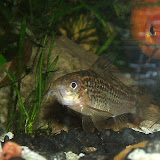 |
| Corys |
Thursday, 17 January 2008
Guyanese fish
My new Guyanese fish (Glowlight tetras, Hemigrammus erythrozonas) seem to be adapting to their new home. They are pretty fish, and they look good among the plants. Unfortunately, they aren't terribly active. Not only do they move around less than the Corydoras panda and Corydoras trilineatus, they actually use less of the tank (vertically) than do the pandas.
In their favour, the Glowlights tend to school, and when they move together, it's an impressive sight. That probably means that I need a lot more than six of them - the more there are, the bigger the impact. In addition, of course, they are also likely to be bolder in larger groups. Hopefully, as they get more accustomed to their new homes, the Glowlights will start using more of the water column. One can hope, anyway.
In their favour, the Glowlights tend to school, and when they move together, it's an impressive sight. That probably means that I need a lot more than six of them - the more there are, the bigger the impact. In addition, of course, they are also likely to be bolder in larger groups. Hopefully, as they get more accustomed to their new homes, the Glowlights will start using more of the water column. One can hope, anyway.
Tuesday, 15 January 2008
The real Corydoras aeneus
Ian Fuller has an interesting article about Corydoras aeneus online at Practical Fishkeeping. The species was first described by Gill from fish collected in Trinidad - consequently, Trinidadian populations of C. aeneus are most likely to be true representatives of that species. Given their proximity, Venezuelan C. aeneus should be closest to the Trinidadian form. However, Fuller points out that there are three distinct Venezuelan forms: the typical form, C. aeneus 'Black' and a third form that Fuller considers a distinct species, C. venezuelanus Ihering, 1911. There are several other varieties that Fuller believes should be maintained as separate species. Some of these have been described as distinct species in the past.
Fuller finds it dubious that such different forms are the same species, especially since they are found in such far-flung locations as Trinidad, Argentina and Peru, in river systems that have been unconnected for millions of years. I suppose a good molecular study might be able to shed some light on the relationship within this group - at the very least, whether they form a monophyletic group or whether other species are nested within the group. If they are sister taxa, then the matter of whether they are the same or different comes down to the opinions of lumpers and splitters.
Fuller finds it dubious that such different forms are the same species, especially since they are found in such far-flung locations as Trinidad, Argentina and Peru, in river systems that have been unconnected for millions of years. I suppose a good molecular study might be able to shed some light on the relationship within this group - at the very least, whether they form a monophyletic group or whether other species are nested within the group. If they are sister taxa, then the matter of whether they are the same or different comes down to the opinions of lumpers and splitters.
Sunday, 6 January 2008
Otocinclus and Corys
I found another two of the "trilineatus-type" corys at another pet store today. That gives me a total of six of them - hopefully it will get me some good schooling behaviour. I was looking for characins again, but once again nothing jumped out at me. Nothing but corys, that is. The two I bought were in a tank of "spotted Corydoras"; I have two of the other species, but I didn't want to buy too many fish today. I was also tempted to get some more Corydoras aeneus and maybe to finally buy some C. paleatus, but I managed to resist the temptation.
I actually went to the pet store in search of some Otocinclus - the February issue of Tropical Fish Hobbyist has a good article on them by Gary A. MacDonald of TropicalResources.net. MacDonald says that not only are Otocinclus very social fish (and recommends that they never be kept in groups of less than three), but when the groups exceed 12 individuals interesting dominance hierarchies emerge. Having read that, I felt the need to expand my collection - after all, I only have two in my main tank. Unfortunately, the pet store only had two left. Since I have no way of being sure which species of Otocinclus I have, I would rather purchase a bigger group - that way I'm more likely to get several of the same species.
I actually went to the pet store in search of some Otocinclus - the February issue of Tropical Fish Hobbyist has a good article on them by Gary A. MacDonald of TropicalResources.net. MacDonald says that not only are Otocinclus very social fish (and recommends that they never be kept in groups of less than three), but when the groups exceed 12 individuals interesting dominance hierarchies emerge. Having read that, I felt the need to expand my collection - after all, I only have two in my main tank. Unfortunately, the pet store only had two left. Since I have no way of being sure which species of Otocinclus I have, I would rather purchase a bigger group - that way I'm more likely to get several of the same species.
Subscribe to:
Posts (Atom)