Showing posts with label platies. Show all posts

Thursday, 20 December 2007

Timeline of infection

A parasitic nematode like Camallanus needs to get into the aquarium from somewhere. I've been thinking about possible paths of infection. According to Levsen and Berland (2001) Camallanus cotti takes 11 days to fully develop in its copeopd host, and then another 34-42 days to develop after it is ingested by a fish host. Presumably the adult feeds for at least a few days before it extrudes from the anus of the fish and starts releasing larvae of its own. Levsen (2001) found that it took a minimum of 62 days and a maximum of 110 days for visible signs of the parasite in a system with monoxeny - direct (fish to fish) infection. Since I first saw signs on the worms in mid-December, they became infected somewhere between early September and early November. That said, I first noticed the worms last weekend, and once I looked there were worming hanging out of several Macropodus.

In that time period I bought (and didn't adequately quarantine) quite a few fish. The fighter is an unlikely culprit - not only did we buy him too recently, he also shows no signs of infection. The pygmy corys are also unlikely, since they have never been in the main tank. On the other hand, the plant tank has a population of copepods, so I would only have to introduce the copepods, not actually any fish. It's reasonable that Camallanus was introduced with infected copepods that came with the Java moss. The timeline is reasonable - about 55 days. I also transferred a couple larger corys from the plant tank to the main tank, and an Otocinclus. They are also potential sources of infection.

There are, of course, other possibilities. I bought three batches of neon tetras this Fall, and had remarkably high mortality. I also bought some ghost shrimp. The ghost shrimp themselves are unlikely vectors - I have not read about Camallanus infecting shrimp, although there's a slight chance that they were using them as secondary hosts. The neons, on the other hand, are another story.

I bought my first batch of neons back in early September. Four of the five died within two days, and that was followed by a wave of mortality: a fighter, two Angels, two platies and a couple Macropodus. It seems pretty obvious that they weren't the ""cleanest" of fish. The extra burden of Camallanus infection could be blamed for the death of the neons (if you're already feeding parasitic worms, you have fewer resources with which to handle stress), it seems unlikely that transmission of the Camallanus larvae could have resulted in such rapid mortality among the other fish.

While I initially blamed the pet store, the deaths of the other fish led me to wonder whether something had gone wrong with my water, and that the timing might have been coincidental. Anyway, the sole survivor remained in the tank, seemingly healthy, but with a shrunken abdomen (which was always a cause for concern). He died a couple months later, after I bought some more neons to keep him company.

I'm most inclined to blame the neons (or more specifically, the one neon). And while I could do a lot to improve my quarantine procedures, segregating new fish for 2 to 4 months just isn't something I can do at present. While I hate the idea of medicating new fish as a precautionary measure, I can see why people would do it.
  1. Levsen, A. (2001). Transmission Ecology and Larval Behaviour of Camallanus cotti (Nematoda, Camallanidae) Under Aquarium Conditions . Aquarium Sciences and Conservation, 3(4), 315-325. DOI: 10.1023/A:1013137801600
  2. Levsen, A., Berland, B. (2002). The development and morphogenesis of Camallanus cotti Fujita, 1927 (Nematoda: Camallanidae), with notes on its phylogeny and definitive host range. Systematic Parasitology, 53(1), 29-37. DOI: 10.1023/A:1019955917509

Friday, 7 September 2007

Life and death

...luckily, without life in death.

Only one of the neons survived the weekend, which is really sad. It may have been a water-quality thing, I'm really not sure. Yesterday was truly tragic - my fighter, an angel and one of the platies all died. I was worried about the angel - it had a large gash on its side on Thursday morning. I was saddened, but not shocked, that it had died. But I'm not sure what killed the other fish. I did a major water change, but I'm not sure what else I could have done. But to little avail - now a second one of my angels is dead. It's really sad - they had grown into such nice big fish. I really wonder if the neons didn't bring some disease - why don't I quarantine new fish? You'd think I would have learned my lesson.

And in terms of life, the plant tank is full of Macropodus fry. I was hoping if I didn't feed them they wouldn't make it, but that isn't the case - there seems to be enough in there for them to eat...protists feeding on a healthy growth of algae and bacteria, I suppose.

Tuesday, 3 July 2007

Still there

It would appear that I still have fish!

I finally cleaned the tank for the first time in far too long and it appears that I still have most of my fish. There's only one Otocinclus left, but I hadn't seen any for weeks. And I think one of the baby Macropodus didn't make it.

Cleaning and a water change (and more importantly, addition of new water) has brought the tank to life. The platies are going crazy. Amazingly, in a tank full of semi-aggressive fish (seven Macropodus in there right now) it's the platies that are doing the most fighting. One of the "younger" males seems to be challenging the largest of the "older" males for dominance. Fresh water always brings platies to life - not that the males don't harass the females all the time anyway.

I'm really not sure what the deal is with the female platies. I have yet to see any more babies, but in the current set-up, I doubt they would survive (the Macropodus and the angels are good hunters, and there are just too many of them). While I was convinced that I had never seen any of the females get any slimmer, I am no longer able to say that definitively. I just didn't pay enough attention to them for a length of time - and some of them don't seem as fat as they used to be. One of them has gotten huge.

Tuesday, 24 April 2007

New pictures

Actually they're about a week or two old, but I just downloaded them from the camera. I also went back to some of the older postings and added pictures. The largest of the angels with three of the "baby" platies (now all grown up).

Two of the original corys (sold to me as Corydoras aeneus, but clearly some other species).

One of these non-aeneus corys, with what I believe to be a true C. aeneus and a Panda cory (C. panda).

Friday, 2 March 2007

Hospital tank

About a week ago I moved two platies to the "hospital" tank. A male that was looking really bad - he had significant tail rot, and a female that wasn't looking too good. I treated the tank with Melafix, and hoped for the best. The female died a few days later, but the male seems ok. His tail hasn't healed yet, but the large whitish spot at the base of his tail (which he has had for several weeks) is almost gone.

I believe that his main problem was bullying - he was the second largest male, and had been harassed a lot by the largest male. While that fish has almost doubled in size since I have him, this male hasn't grown much. Until today the male in the hospital tank hasn't looked very happy - he spent a lot of his time sitting near the surface with his fins clamped - today he's much more active, poking around the bottom of the tank (and finding something edible, by the look of it). Hopefully he's finally on the mend. I still think his main problem was social, not water quality or disease per se. Hopefully I'll be able to get a second tank this weekend and move him into it. It might be worth making it a male-only tank (for platies, at least) - put him and the two smaller males in there - without females to fight over they may get on better. Probably have to move the male babies across there too.

Of course, this still leaves the question of what I want to do with the platies.

Friday, 16 February 2007

Sick fish

Initially the female platies looked significantly stressed, but since the major water change it has been the males that look worse. Basically the water change sent to platies sex mad, and the largest male started bullying the smaller males. The second largest male is the one the got the most harrassment (perhaps because he was more willing to stand up to the largest male, unlike the smaller males who just ran). Anyway, he has had a moderately large whitish patch at the base of his tail fr a couple days - it looks more bacterial than fungal, but I am hesitant to add an anti-bacterial to the tank for fear of disrupting the biofiltration. I added Stress Coat - not sure if it will help, but anything that speeds wound healing (it's basically aloe vera) has some potential to help the fish. I'll see what happens - if need be, I'll isolate him and treat him with something stronger.

Tuesday, 13 February 2007

Mother of millions (or a dozen, anyway)

This is a shot of the first female platy, in the interval between giving birth and dying. I really just did this to try out the go@blogger.com feature which lets you email images from your phone to your blog. But anyway, that was one of my platies, on an Echinodorus leaf. Hopefully this makes the blog a little more visually appealing (I think it matches the background colour pretty well).

Monday, 12 February 2007

Dramatis personae I: the platies

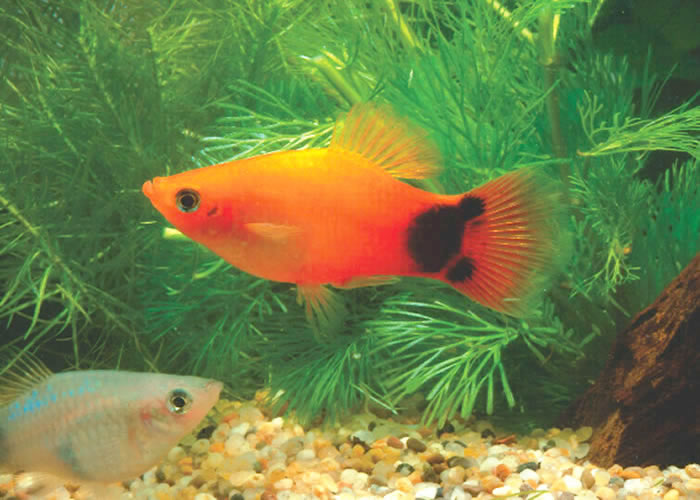
Since they were the first fish I bought for the tank, I should introduce the platies first. My first purchase was a group of five "sunset coral dwarf platies". I asked for 2 males and three females (they recommend 2:1 female to male sex ratios for platies), but turns out the guy at Petsmart couldn't tell a female platy from a male and I ended up with four males and one poor female...who was very pregnant from the start. (I don't have any pix uploaded, but this is a picture of sunset coral dwarf platies).

As I mentioned before, I returned to the petshop a few days later and got 3 more (female) dwarf platies, and one (female) "mickey mouse platy" which looked something like this one. Shortly thereafter the first female had babies, and a day or so later I noticed major fin rot on both her and the "mickey mouse" platy. Without knowing what to do, I separated out the sick fish...and they died overnight. But after a 10% water change and an increase in temperature, the rest of the fish were ok. Since then, and especially now since my second water change, the male platies are going crazy, trying to mate with everything else (including the Corys). The females (and the second largest male) are looking pretty harrassed. Two of the females are huge with babies - the smallest (and fattest) female is ridiculously large.

And then there are the real stars of the aquarium - the platy fry. But I've said enough about them already.

Fry

As of this evening (prior to the water change) we appear to have 12, maybe 13 fry. It's quite a difference from the two or three I initially thought survived. A few days ago I was thrilled with four fry. Now there are a dozen.

I'm really impressed with the fry. They have real personality, real spunk. It's one thing to see them grab a piece of flake food the size of their head. It's even more impressive when they go after the Cory food. The Cory food sinks, obviously, and the platies are as eager to go for it as anyone. It's one thing when the adults grab at it, or try to approach the (far larger) Corys to grab a bit. It's even more impressive when a platy fry finds an untended piece of food and take a bit of something more than five times their size.

Sunday, 11 February 2007

Babies

The large female platy (the only female in the first bunch) gave birth to babies a day or two before she died. Since the tank was moderately planted, a few survived. I noticed that they were able to dive down between the gravel, which probably provided a better hiding place than the plants. To begin with I saw two or three babies. After a few days they became bolder, since the adults didn't both them. Eventually I figured there were at least four fry, and eventually confirmed a fifth.

For a few days I accepted the figure of five, but yesterday I started to wonder if there weren't more. This morning I confirmed 10 fry, some happily nibbling at flakes on the surface, while others were pecking at the Cory food on the bottom.

Beginning

Linz got me an aquarium for my birthday, and so the adventure began. After a 20+ year hiatus, I was once again fish-crazy. And I made a new discovery - cycling. Back in "the old days" the books I had never mentioned cycling. No one talked about "New Tank Syndrome". It made sense to me - after all, I'm an ecologist, I am aware of the nitrogen cycle. But it still seemed an awful imposition :)

Anyway, with a 55-gallon tank and "magic" bacterial cultures to add, I figured I could cheat a bit. So I added plants, figuring they would help things along, and Linz's fighter. And after a couple days I bought a few platies. That's where the problem started - everything I read said more females than males, so I asked for 3 females and two males. I figured that the guy at the pet store should know what he was up to, but once I got them home and had a look at them I realised that I had four males and one female. So a few days later, since she was being harrassed so much, I added four more females. And, of course, some Corys.

A few days later, after the first female had given birth, I noticed fin rot on her and one other the other females. Not sure what that meant, I moved them into the old fighter tank, where they promptly died. (The fighter had also expired the previous day - I felt really badly, since he wasn't mine). Only then did I got looking online, and realise that rather than being a contagious disease, fin rot was most likely to be a symptom of bad water quality. So I did a water change - about 10%, because I didn't want to mess up the cycling too much.

The next day I noticed that the remaining females in the tank didn't look well either, and had some fin rot. I was going to attribute it to (harrassment by the males, but then I noticed "shimmying", and I remembered seeing something about it on a disease page. So I looked into it, and realised that my water temperature was set really low. I raised it any everyone seemed happy.